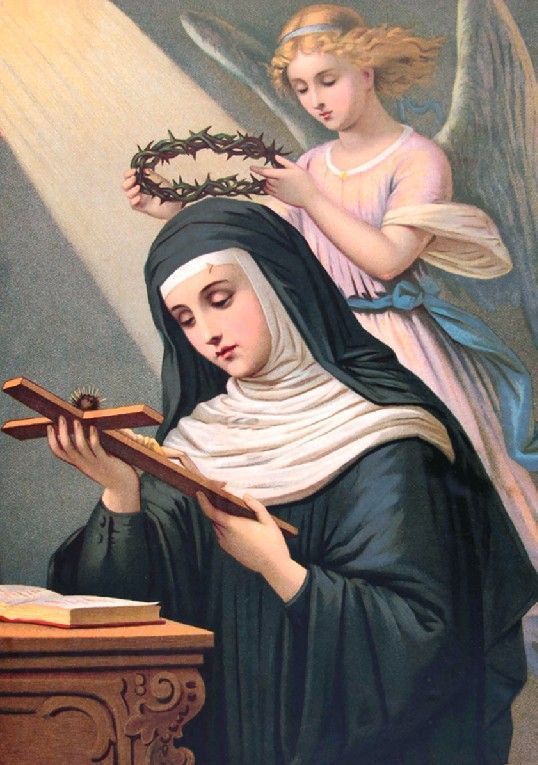
Saint Rita of Cascia
Rita of Cascia (c. 1381–1457) was a blessed Augustinian of the fifteenth century, venerated as the patron saint of impossible and desperate causes
CHILDHOOD AND MARRIAGE
Born Margherita Lotti around 1381 in the hamlet of Roccaporena, near Cascia in the Umbrian region of central Italy, Rita was the only child of devout and already elderly parents, Antonio and Amata. From childhood she was drawn to a life of prayer and longed to enter a convent, but in obedience to her parents she instead accepted the marriage they arranged for her while she was still very young.
Her husband, Paolo Mancini, was a man of harsh and violent temper with many enemies, and the early years of the marriage brought Rita great suffering. She bore him two sons. Tradition holds that through patience, gentleness and constant prayer she gradually softened his heart, until he repented of his old ways — only to be murdered in one of the blood feuds that plagued the region.
FORGIVENESS AND RELIGIOUS LIFE
At his funeral Rita publicly forgave the killers, but her two sons, now nearly grown, resolved to avenge their father. Unable to change their hearts by words, she prayed that God would take them before they could stain their souls with murder; both died of illness not long after. Left without husband or children, Rita turned wholly to God.
She sought admission to the Augustinian monastery of Saint Mary Magdalene in Cascia. Refused more than once — in part because of the lingering feud surrounding her husband's death — she was at last received, after helping to reconcile the two families. According to tradition she was brought into the cloister miraculously, through the intercession of her patrons John the Baptist, Augustine and Nicholas of Tolentino. There she lived some forty years in prayer, penance and humble service.
STIGMATA AND DEATH
Late in life, while praying before an image of Christ crowned with thorns, Rita received a wound on her forehead, understood as a partial stigmata, which she bore until her death. According to tradition, in her final illness she asked a relative to bring a rose and figs from the garden at Roccaporena; though it was deep winter, both were found in bloom. She died on 22 May 1457.
VENERATION AND LEGACY
Her body was found to be incorrupt and is venerated to this day in the Basilica of Santa Rita in Cascia. Beatified by Pope Urban VIII in 1627 and canonized by Pope Leo XIII on 24 May 1900, she was given the title "Patroness of Impossible Causes." She is invoked in desperate and lost causes, in troubled and abusive marriages, and as the protector of widows, mothers and the sick. She is most often depicted with the wound on her brow, with roses, and with bees.