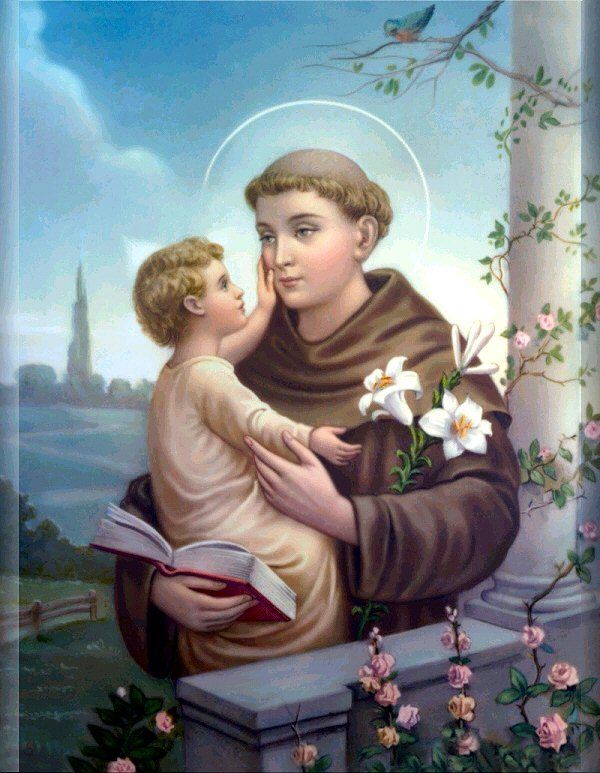
Anthony of Padua
Franciscan friar, priest and Doctor of the Church. Born in Lisbon, died in Padua. One of the most venerated saints of the Catholic world, hailed as the 'Wonder Worker' and 'Hammer of Heretics'. Canonised one year after his death — one of the fastest in the history of the Church.
BIRTH AND FIRST CALLING
Fernando Bulonne was born in Lisbon in 1195. Between the ages of fifteen and twenty he entered the Canons Regular of Saint Augustine, whose monastery stood on the outskirts of Lisbon. He spent two years there before transferring to the monastery in Coimbra — a city that, alongside Lisbon, was the most important centre of religious and cultural life in the country.
There he received a thorough theological education and was ordained to the priesthood in 1219.
JOINING THE FRANCISCANS
A year later Fernando witnessed the funeral of five Franciscans martyred by Muslims in Morocco. Hearing for the first time of the spiritual sons of Saint Francis of Assisi, he immediately joined them at Olivanez, where they had settled near the little church of Saint Anthony the Hermit. On this occasion Fernando took the name Anthony.
Fired with the spirit of martyrdom, he resolved to travel to Africa and give his life for Christ. But God's plans were different — Anthony fell gravely ill and had to return home. A storm on the Mediterranean drove his ship to Sicily. In 1221 the new order held its general chapter in Assisi; Anthony went there and met Saint Francis himself (†1226). After the chapter he placed himself under the authority of Brother Gratian, provincial of Emilia and Romagna, who assigned him to the hermitage at Montepaolo near Forlì.
Anthony used his time there to deepen his interior life and his studies, immersing himself above all in Sacred Scripture. At the same time he provided pastoral assistance and preached. The fame of his sermons soon reached Brother Elias, the successor of Saint Francis, who appointed him general preacher of the order.
PREACHER AND THEOLOGIAN
From that point Anthony travelled from town to town calling people to reform and penance. His gift of eloquence, vivid and pictorial language, ascetic bearing, zeal, and the miracles that accompanied him drew such vast crowds that he was forced to preach in public squares, since no church could hold the audience. Between 1225 and 1227 he preached in southern France, vigorously combating the spread of the Cathar (Albigensian) heresy.
On his return to Italy he was elected minister (provincial) of Emilia and Milan at a general chapter. During this period he composed his Sunday Sermons. In 1228 he went to Rome to attend to urgent affairs of his province; Pope Gregory IX invited him to preach on that occasion. The sermon made so powerful an impression on the Pope that he called Anthony the «Ark of the Covenant». At the request of the Cardinal of Ostia, Anthony also wrote the Sermons on the Feasts.
After returning to his province he went to Verona, where the ruler was the notoriously cruel and tyrannical Duke Ezzelino III — a supporter of the emperor who took particularly savage revenge on the partisans of the Pope. Anthony knew he was risking his life, yet had the courage to speak the truth to the ruler. To everyone's astonishment, the tyrant did not dare touch him and let him go unharmed.
DEATH AND CANONIZATION
Anthony was endowed with many charisms — the gifts of bilocation, reading human consciences, and prophecy. He lectured in philosophy at the University of Bologna. In 1230 he resigned his office as provincial at a general chapter and went to Padua, utterly exhausted and suffering from dropsy. His strength failing, he stopped at the little monastery at Arcella, where on the evening of Friday, 13 June 1231, as the O gloriosa Virginum was being sung, he gave his spirit to God at the age of only thirty-six.
He was buried in Padua in the church of Our Lady. Less than a year later, on 30 May 1232, Pope Gregory IX numbered him among the saints. The speed of his canonization was determined by the many miracles recorded at his tomb: the papal commission documented 5 cures of paralysis, 7 cases of sight restored to the blind, 3 of hearing to the deaf, 2 of speech to the mute, the healing of 2 epileptics, and 2 cases of resurrection from the dead. Gregory IX's bull Cum iudicat (1233) fixed 13 June as his annual feast day; Sixtus V added it to the universal calendar of the Church in 1586. In 1946 Pius XII proclaimed him a Doctor of the Church.
PATRONAGE AND ICONOGRAPHY
Saint Anthony of Padua is patron of the Franciscan and Antonian orders and many confraternities; of Padua, Lisbon, Paderborn, and Split; of children, miners, married couples, engaged persons, women in labour, the poor, travellers, and of lost people and things. On the site of his tomb — Il Santo — stands the great basilica of Padua, one of the most visited shrines in Europe.
An examination of the saint's remains carried out in 1981 established that he was 190 cm tall, with an elongated face and dark brown hair; thin fractures on his knees were attributed to prolonged kneeling. In iconography Anthony is depicted in the Franciscan habit — often preaching or holding the Christ Child, who according to legend appeared to him. His attributes include a book, lily, heart, fire as a symbol of zeal, a loaf of bread, a donkey, and a fish.